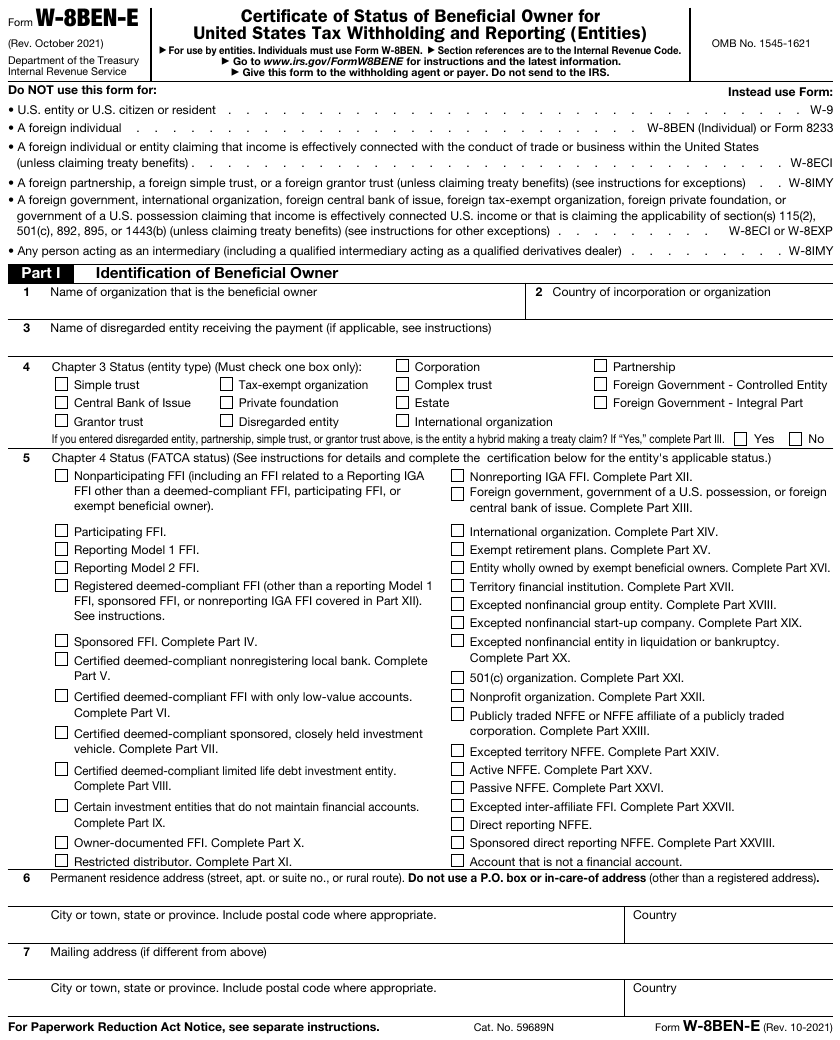
Who completes it and who asks for it
A foreign entity that is the beneficial owner of U.S.-source income completes Form W-8BEN-E: a foreign corporation, a foreign trust or estate, a foreign partnership or LLC that is treated as a corporation, a foreign tax-exempt organization or foundation that is not claiming W-8EXP treatment, and a disregarded entity's foreign owner (the owner completes it; a disregarded entity with its own GIIN uses Part II). Flow-through entities and intermediaries that are not beneficial owners use W-8IMY; foreign governments and international organizations may use W-8EXP; income effectively connected with a U.S. business goes on W-8ECI.
Withholding agents request it for the same payments as the W-8BEN: interest, dividends, royalties, rents, fees for services performed in the United States, and any other FDAP income. Foreign financial institutions request it from entity account holders to classify them for FATCA. A vendor that is a plain foreign operating company paid for goods or for services performed abroad often needs the form only to document that no withholding or reporting applies.
The parts that matter
| Part | What goes there | Where it goes wrong |
|---|---|---|
| I, lines 1 to 4 | Legal name, country of organization, and chapter 3 status (corporation, partnership, trust, and so on; a disregarded entity checks the box and gives the owner's status). | Trade name instead of registered name; partnership checked when the entity is a beneficial-owner corporation; a disregarded entity completing the form in its own name. |
| I, line 5 | Chapter 4 (FATCA) status: one of about thirty categories (participating FFI, reporting Model 1 FFI, active NFFE, passive NFFE, excepted nonfinancial entity, and others), each pointing to a certification part. | Left blank when the payment is a withholdable payment; "active NFFE" checked by an investment vehicle that is passive; the referenced part not completed. |
| I, lines 6 to 9 | Permanent residence address (no P.O. box or in-care-of), U.S. TIN if any, GIIN for FFIs, foreign TIN. | U.S. address; GIIN missing or not matching the IRS FFI list. |
| III. Treaty claim | Treaty country, the limitation-on-benefits box that applies (publicly traded, subsidiary of a publicly traded company, active trade or business, and so on), and the article and rate for special rates. | Treaty claimed with no LOB box checked, which invalidates the claim; rate claimed for the wrong income type. |
| IV to XXVIII. Chapter 4 certifications | The part matching the line 5 status; passive NFFEs list substantial U.S. owners in Part XXIX or certify there are none. | The wrong part completed; owners omitted. |
| XXX. Certification | Signed under penalties of perjury by an authorized person, with the capacity box checked. | Unsigned; signed by a payer's employee on the vendor's behalf. |
What the withholding agent relies on
A valid form supports treating the payee as foreign, applying a treaty rate, and classifying the entity for chapter 4 so the agent knows whether 30% FATCA withholding applies to withholdable payments. Validity is the same three-year rule as the W-8BEN, with the status portions indefinitely valid once paired with documentary evidence before either expires. The agent must check a GIIN against the IRS FFI list within 90 days, and may not rely on a treaty claim that lacks the LOB certification or, for most income, a TIN. The presumption rules for undocumented entity payees are less forgiving than for individuals: an undocumented entity receiving a withholdable payment is treated as a nonparticipating FFI, withheld on at 30% under chapter 4 with no treaty relief.
Where these go wrong
- Vendors who give up. The form's length produces incomplete submissions; for a foreign operating company paid for services performed abroad, Parts I (lines 1 to 6), III if a treaty is claimed, the chapter 4 part for an active NFFE (Part XXV), and Part XXX are usually all that is needed. Tell them which parts.
- Name versus registered name. The name on the form must be the entity's legal name; a 1042-S under a trade name does not match anything.
- Chapter 4 status on non-withholdable payments. Services and most royalties are not withholdable payments; a missing line 5 does not invalidate the form for chapter 3 purposes in that case, but agents often reject the form anyway.
- Expiry. Same December 31 of the third year rule; calendar it.
Questions people ask about Form W-8BEN-E
Our foreign vendor sent a W-9.
A foreign entity cannot certify U.S. status; return it and request a W-8BEN-E. If the vendor has a U.S. subsidiary that is the actual payee, that subsidiary gives a W-9.
Which parts does a typical foreign supplier need?
Part I lines 1 to 6 (and 9b for a foreign TIN on financial accounts), Part III if claiming a treaty rate with the LOB box, the chapter 4 certification part matching line 5 (commonly Part XXV, active NFFE), and Part XXX.
Does the form need a U.S. TIN?
Only to claim treaty benefits on most income, or for effectively connected income; documenting foreign status alone does not.
How long is it valid?
Through December 31 of the third year after signature unless circumstances change; the status certifications can become indefinitely valid with documentary evidence.
The other certification forms
W-9 · W-9S · W-8BEN · W-8ECI · W-8EXP · W-8IMY · Comparison table
Sources: Form W-8BEN-E and instructions (Rev. October 2021); Instructions for the Requester of Forms W-8 (Rev. June 2022); Publication 515; Regulations 1.1441-1 and 1.1471-3.