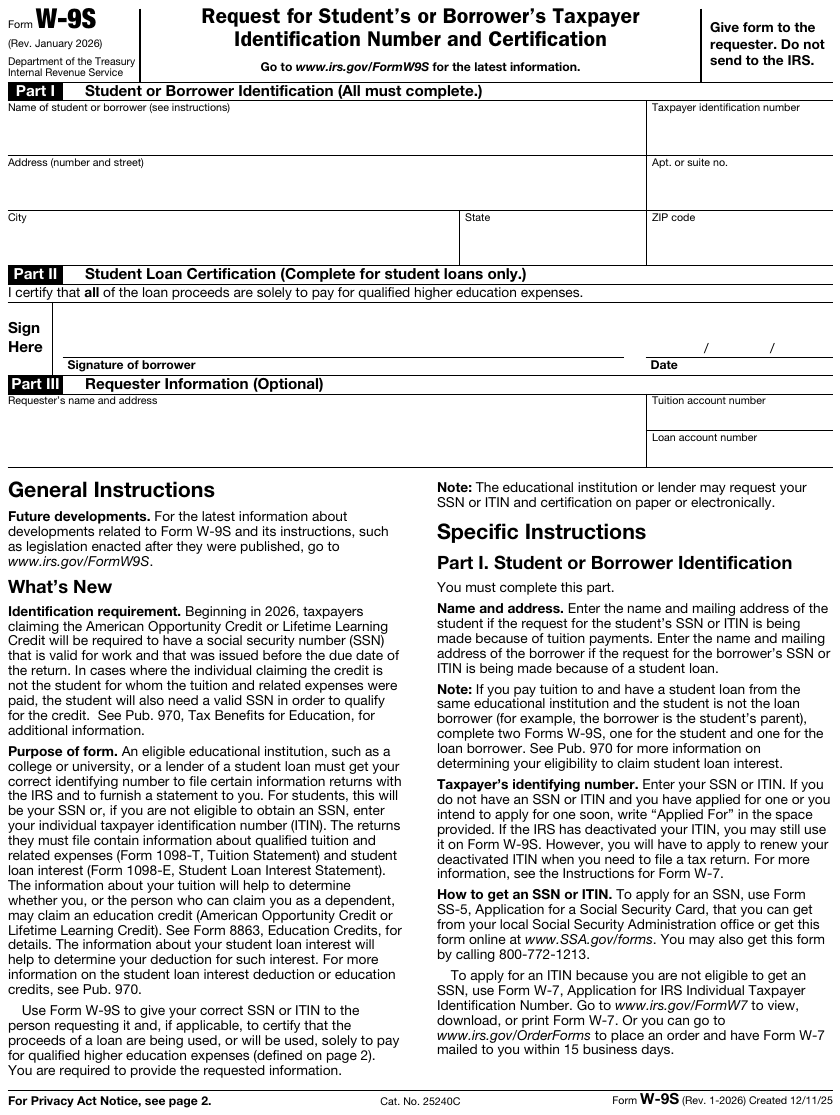
Who completes it and who asks for it
A student completes Part I and Part III when an eligible educational institution requests it for Form 1098-T reporting; a borrower completes Parts I, II and III when a lender or loan servicer requests it for Form 1098-E. The institution or lender is the requester. The form is optional in the sense that the requester may collect the same information another way (an admissions application, a loan application, an electronic system that meets the W-9 rules), but the certification in Part II is what makes a loan a qualified student loan for reporting purposes.
The lines that matter
| Part | What goes there | Where it goes wrong |
|---|---|---|
| I. Name, address, TIN | The student's or borrower's legal name and SSN (or ITIN); a student who has applied for a number writes "Applied for". | Preferred names from the admissions system; a parent's SSN on a student's form. |
| II. Student loan certification | The borrower certifies that all loan proceeds are used solely to pay qualified higher education expenses. | Missing for mixed-use loans, which then are not reportable as student loan interest. |
| III. Certification | Signature; the TIN certification is not under penalties of perjury for the student, unlike a W-9. | Unsigned loan certifications. |
What the requester relies on
The requester keeps the form and uses the TIN on Forms 1098-T and 1098-E. Publication 1586 excludes telephone solicitation for these two forms, so the request is written or electronic; an electronic W-9S system must meet the same authentication and record requirements as an electronic W-9. An educational institution that has properly solicited the TIN and still lacks it files with the TIN blank, checks the certification box on the 1098-T, and is not penalized for the missing TIN. Nothing here triggers backup withholding: tuition and loan interest flow to the requester, not from it.
How this form produces notices
- Names captured for a different purpose. Student information systems carry preferred names; the 1098-T needs the SSA name. Reconcile at enrollment.
- Borrowers who marry after graduation are the classic 1098-E mismatch; a name change at the SSA after the W-9S was signed makes the pair fail.
- Parent PLUS loans. The parent is the borrower and signs the W-9S; the student's SSN belongs on the 1098-T, not the 1098-E.
Questions people ask about Form W-9S
Is the W-9S required?
No specific form is required; the institution or lender must solicit the TIN and, for loans, obtain the qualified-expense certification, and W-9S is the IRS form for it.
Can it be collected electronically?
Yes, through a system that authenticates the student or borrower, captures the same information and, for the loan certification, ends with an electronic signature.
What if a student refuses?
Keep the written solicitation, file the 1098-T with the TIN blank and the certification box checked; the penalty does not apply when the solicitation rules were followed.
The other certification forms
W-9 · W-8BEN · W-8BEN-E · W-8ECI · W-8EXP · W-8IMY · Comparison table
Sources: Form W-9S (Rev. January 2026); Instructions for Forms 1098-E and 1098-T (2026); Publication 1586 Part V; Regulations 1.6050S-1 and 1.6050S-3.