Who completes it and who asks for it
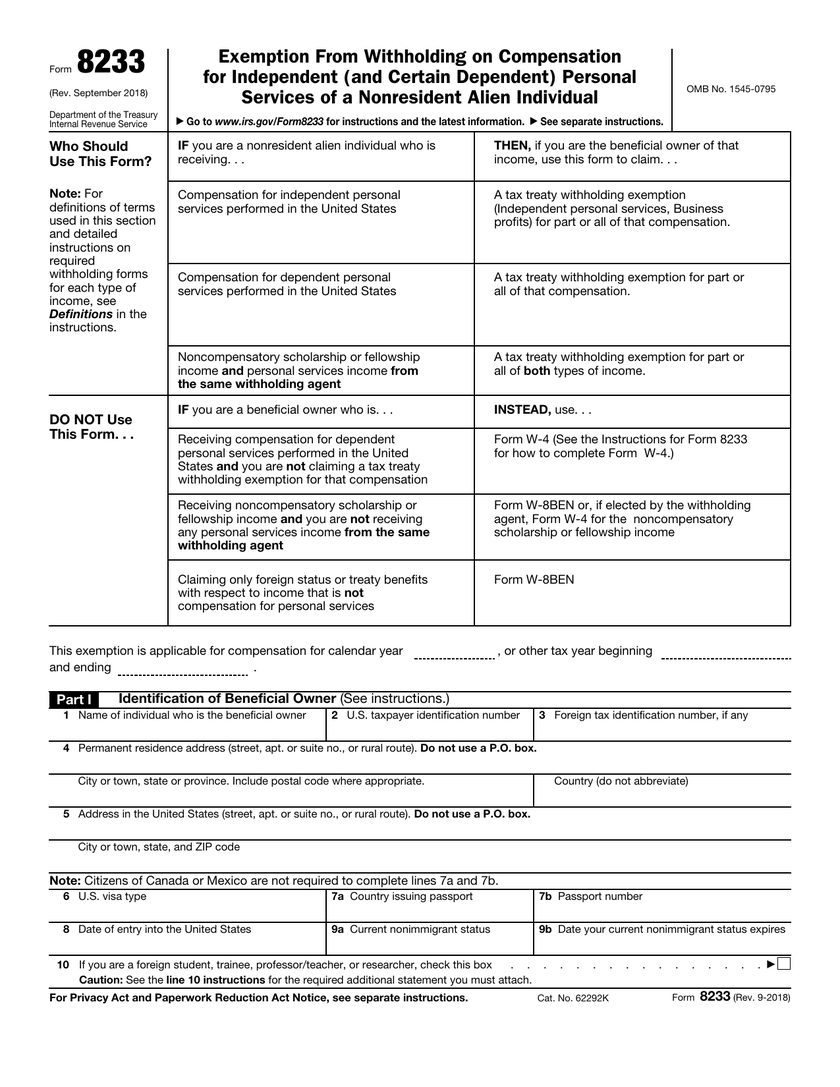
A nonresident alien individual who is paid for personal services performed in the United States, and claims that a tax treaty exempts some or all of that pay from withholding, completes Form 8233 and gives it to the payer. It covers pay for independent personal services (a consultant, speaker or performer working as a contractor), certain dependent personal services (wages a treaty exempts, most often for students, trainees, teachers and researchers), and noncompensatory scholarship or fellowship income, the last only when the same withholding agent also pays the person for services.
It is the wrong form when the payee is not claiming a treaty exemption for services pay (an employee completes Form W-4 under the nonresident alien rules; a contractor gives a W-8BEN and is withheld on at 30%), when the only income is a noncompensatory scholarship (W-8BEN), or when the income is not pay for personal services at all, such as royalties (W-8BEN). Pay for services performed entirely outside the United States is foreign-source and needs no treaty claim.
A separate Form 8233 is required for each tax year, each withholding agent and each type of income. A visiting professor who also lectures at other institutions gives a separate form to each one.
The lines that matter
| Line | What goes there | Where it goes wrong |
|---|---|---|
| Tax year, above Part I | The calendar year (or other tax year) the exemption covers. | Left blank, or last year's form reused. A new form is needed every year. |
| 2. U.S. TIN | Required. An SSN in most cases; an ITIN if the person is not eligible for an SSN. While a number is pending, a copy of the filed Form W-7 or SS-5 can be attached. | Blank, or an expired ITIN. |
| 4 and 5. Permanent residence abroad; U.S. address | A foreign residence address (no P.O. box) and the address in the United States. | A U.S. address on line 4. Some student and teacher articles allow it, because residence at the time of entry decides, but most claims need the foreign address. |
| 6 to 9. Visa, passport, entry date, nonimmigrant status | Visa type (F-1, J-1, M-1, H-1B), passport country and number (not required for citizens of Canada or Mexico), date of entry, current status and its expiry. | A dependent visa holder (F-2, J-2, H-4) claiming the primary holder's treaty benefits, which are usually not available. |
| 10. Student, trainee, teacher or researcher | The box, plus the attached statement in the format of Publication 519, Appendix A or B. | Box checked with no statement. |
| 11 and 12. Services, expected pay, treaty, article, exempt amount | A description of the services, the total expected from this payer for the year, the treaty and article (for example "Article 7 (business profits)"), the exempt amount ("All" or a dollar figure) and the country of residence. | An article for the wrong kind of income, or an exempt amount above the treaty's dollar cap. |
| 14. Facts justifying the exemption | The facts the article turns on: days present, no fixed base, the purpose of the visit. | Blank, leaving the payer nothing to judge the claim by. |
| Parts III and IV. Signatures | The individual signs Part III under penalties of perjury. The withholding agent signs Part IV to accept it. | Part IV never signed, so the form was never accepted. |
What the withholding agent relies on
The agent reviews the form and, if satisfied that the exemption is warranted, signs the acceptance in Part IV. It makes three copies, each with every attachment: one for the individual, one for its records, and one for the IRS, sent within 5 days of acceptance to Department of the Treasury, Internal Revenue Service, Philadelphia, PA 19255-0725, or by fax to 267-941-1365 (up to 25 pages at a time).
The exemption applies back to the first payment the form covers, but the agent must wait at least 10 days after properly mailing it to see whether the IRS objects. If the IRS objects, or later tells the agent that eligibility is in doubt, the agent withholds on amounts not yet paid.
The agent must not accept the form, and must withhold, if it knows or has reason to know that any statement on it may be false, or that eligibility cannot be readily determined, for example because the person has a fixed base or permanent establishment in the United States. If it learns this after accepting, it notifies the IRS in writing and starts withholding on amounts not yet paid.
Without an accepted Form 8233, pay for independent personal services performed in the United States is subject to 30% withholding, and wages for dependent services follow the wage-withholding rules on a Form W-4. Treaty-exempt payments are still reported on Form 1042-S.
Where these go wrong
- A W-8BEN treaty claim for U.S. services. The W-8BEN cannot claim a treaty exemption for pay for services performed in the United States. It documents foreign status; without a Form 8233 the pay is withheld on at 30%.
- Last year's form. Form 8233 covers one tax year. A contractor who returns in January needs a new one before the first payment.
- A fixed base in the United States. A person with an office or fixed base regularly available in the U.S. generally cannot claim the independent personal services or business profits exemption; a few treaties have limited exceptions.
- Day counts and dollar caps. Many articles end the exemption once the person passes a number of days in the U.S. or a dollar amount for the year. When that happens mid-year, withholding starts on the payments that follow.
- No IRS copy. An accepted form that was never sent to the IRS within 5 days, or payments made without waiting out the 10 days.
- Services performed abroad. A form collected for work done entirely outside the United States. That pay is foreign-source; a W-8BEN documents status and nothing is withheld or reported.
Questions people ask about Form 8233
Is Form 8233 filed with the IRS?
Yes, unlike the W-8 series. The withholding agent sends a copy within 5 days of accepting it. The individual does not file it.
Can a foreign contractor working in the U.S. use a W-8BEN instead?
Not to claim a treaty exemption for that pay. The W-8BEN establishes foreign status only; without an accepted Form 8233 the agent withholds 30%.
How long is it valid?
One tax year, for one withholding agent and one type of income. A new form is needed each year and for each payer.
The payee has no SSN or ITIN yet. Can we accept it?
The form requires a U.S. TIN. If the person has applied, they can attach a copy of the filed Form W-7 or SS-5 showing the application.
Does a treaty exemption mean nothing is reported?
No. Treaty-exempt pay is reported on Form 1042-S, and the individual may still have to file a U.S. return.
The other certification forms
W-9 · W-9S · W-8BEN · W-8BEN-E · W-8ECI · W-8EXP · W-8IMY · Comparison table
Sources: Form 8233 (Rev. September 2018); Instructions for Form 8233 (Rev. December 2025); Publication 515; Publication 519, Appendices A and B; Publication 901; Treas. Reg. 1.1441-4(b).