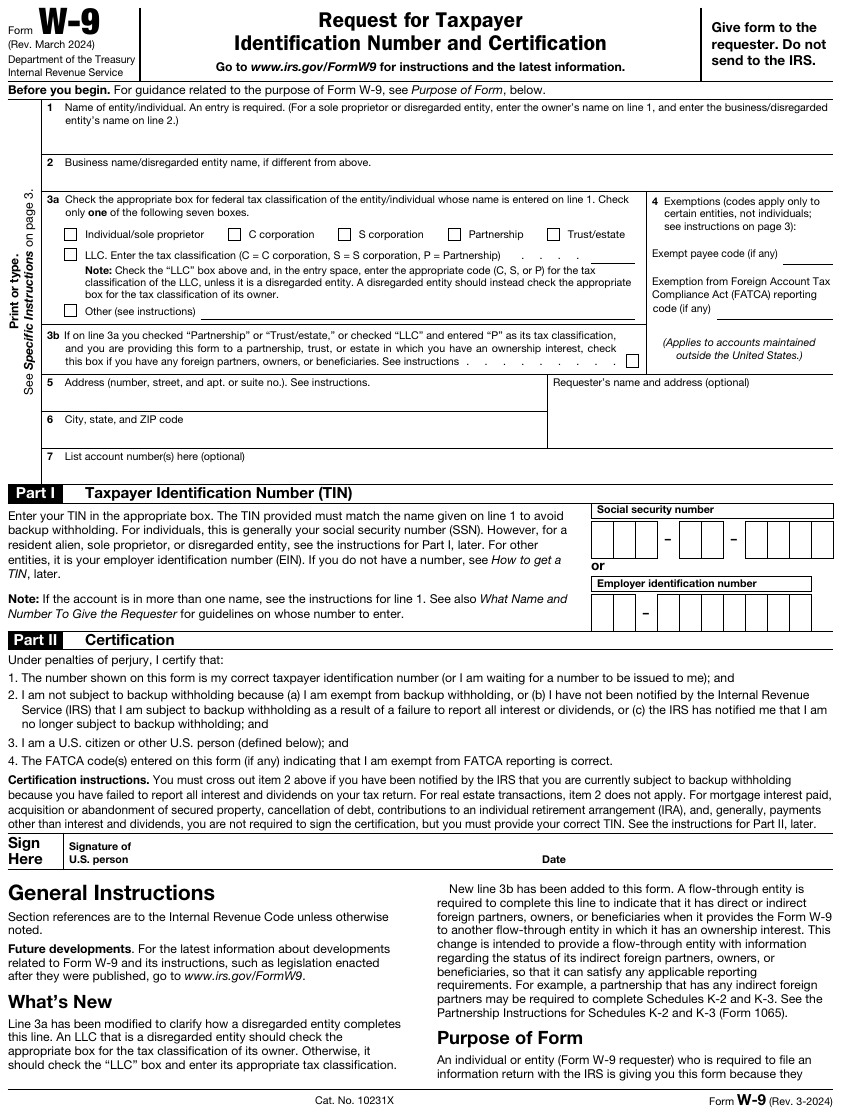
Who completes it and who asks for it
A U.S. person completes Form W-9 when a requester asks: an individual who is a citizen or resident alien, a partnership, corporation, company or association created in the United States, a domestic estate or trust, and a single-member LLC that is disregarded and owned by a U.S. person (which completes the form in the owner's name). Foreign persons use the W-8 series instead, and a U.S. resident alien who relies on a treaty saving clause still uses the W-9.
A requester is anyone required to file an information return: a business paying contractors (1099-NEC), a landlord's tenant or property manager (1099-MISC), a bank or broker (1099-INT, DIV, B), a payment settlement entity (1099-K), a real estate settlement agent (1099-S), a lender (1098, 1098-VLI), a partnership documenting partners for the section 1446(f) rules. The requester may use the official form or a substitute that carries the same certifications; a substitute may be part of an account application as long as the certifications are not tied to unrelated agreements.
The lines that matter
| Line | What goes there | Where it goes wrong |
|---|---|---|
| 1. Name | The name shown on the income tax return: an individual's own name (sole proprietors and disregarded LLCs included); an entity's legal name as on its EIN notice. | Business or DBA name on line 1 with an SSN; a trade name instead of the legal name; the LLC's name for a disregarded LLC. |
| 2. Business name / disregarded entity name | Trade name or the disregarded LLC's name. | Left blank when it would have explained the mismatch, or put on line 1. |
| 3a. Federal tax classification | Individual/sole proprietor, C corporation, S corporation, partnership, trust/estate, or LLC with its tax class (C, S or P); a disregarded LLC checks the owner's box. | An LLC checking LLC with no letter; a single-member LLC checking partnership; this box decides whether the corporate exception applies. |
| 3b. Foreign partners, owners or beneficiaries | Added March 2024: a partnership, trust or estate checks it if it has any foreign partners, owners or beneficiaries and is providing the form to a flow-through entity. | Ignored by requesters; it only matters when the payee is itself a flow-through providing the form to another flow-through. |
| 4. Exemptions | Exempt payee code (1 to 13) for backup withholding; FATCA exemption code (A to M) for accounts at foreign financial institutions. | Codes entered by payees who are not exempt; corporations are code 5 but are not exempt for attorney fees or medical payments. |
| Part I. TIN | SSN for an individual or sole proprietor (the March 2024 form also allows a sole proprietor's EIN); EIN for an entity; the owner's TIN for a disregarded LLC. One box only. | Both boxes filled; the disregarded LLC's own EIN; a number that does not go with the line 1 name. "Applied For" starts a 60-day clock for interest and dividends only. |
| Part II. Certification | Signed under penalties of perjury: correct TIN, not subject to backup withholding (cross out item 2 if notified otherwise), U.S. person, FATCA code correct. | Unsigned forms: a W-9 for interest, dividends or broker proceeds must be signed to count; for other payments the TIN may be furnished in any manner but the signed form is still the evidence. |
What the requester relies on
A requester who receives a signed W-9 may treat the payee as a U.S. person, file without backup withholding, and rely on the exempt payee code. The form has no expiry; it stays valid until a change in circumstances makes it incorrect, so a payee who incorporates, changes name or is notified of an incorrect TIN needs a new one. A W-9 that comes back with the same incorrect pair after a First B-Notice is kept on file and stops withholding; after a Second B-Notice a W-9 no longer cures and only a Social Security card copy or Letter 147C does (Publication 1281).
Electronic W-9s are allowed through a system that authenticates the payee, captures the same information as the paper form, ends with an electronic signature under penalties of perjury, and can produce a hard copy on request; fax counts. The requester must keep the information confidential and use it only for tax compliance.
What is changing. The IRS posted a draft revision in 2026 (January, updated June) that adds a digital-asset-broker certification and, more consequentially, states that a sole proprietor should furnish an SSN and a disregarded entity the owner's TIN rather than an EIN. Until the revision is final, the March 2024 form and its rules apply; when it is, substitute forms will need the new certification and payers may re-solicit sole proprietors who gave an EIN.
How this form produces CP2100 lines
- Line 1 is the whole game. The IRS name control comes from line 1 and is matched against the SSA or IRS record for the TIN. "Riverside Landscaping LLC" with the owner's SSN fails; "Maria Rivera" with the same SSN and Riverside on line 2 passes. See which name goes on the W-9.
- The right TIN for the wrong box. A disregarded LLC that obtained its own EIN for payroll puts that EIN in Part I; the IRS has no 1099 record for it. Use the owner's TIN.
- Old forms. A W-9 from 2015 for a vendor that has since incorporated is a stale certification; the corporate exception cannot be applied without a new form.
- Verification. A W-9 certifies; it does not verify. Payers eligible for the IRS TIN Matching program should run the pair before the first payment, and the name control calculator shows what the IRS will derive.
Questions people ask about Form W-9
Do we send the W-9 to the IRS?
No. Keep it for at least four years after the last return it supported; the IRS asks for it in an audit or a reasonable-cause review.
Can a sole proprietor use an EIN?
Under the March 2024 form, yes, with the individual's name on line 1. The 2026 draft revision would change that to SSN only; watch for the final form.
Is a W-9 required from a corporation?
Not required for exempt payments, but it is how you prove the payee is a corporation. Attorneys and medical providers are reportable even as corporations, so collect one anyway.
How long is a W-9 valid?
Indefinitely, until a change in circumstances or an IRS notice makes it unreliable.
The other certification forms
W-9S · W-8BEN · W-8BEN-E · W-8ECI · W-8EXP · W-8IMY · Comparison table
Sources: Form W-9 (Rev. March 2024) and its instructions; Instructions for the Requester of Form W-9 (Rev. March 2024); Pub 1099 (2026) part J; Publication 1281; IRC 3406, 6109.