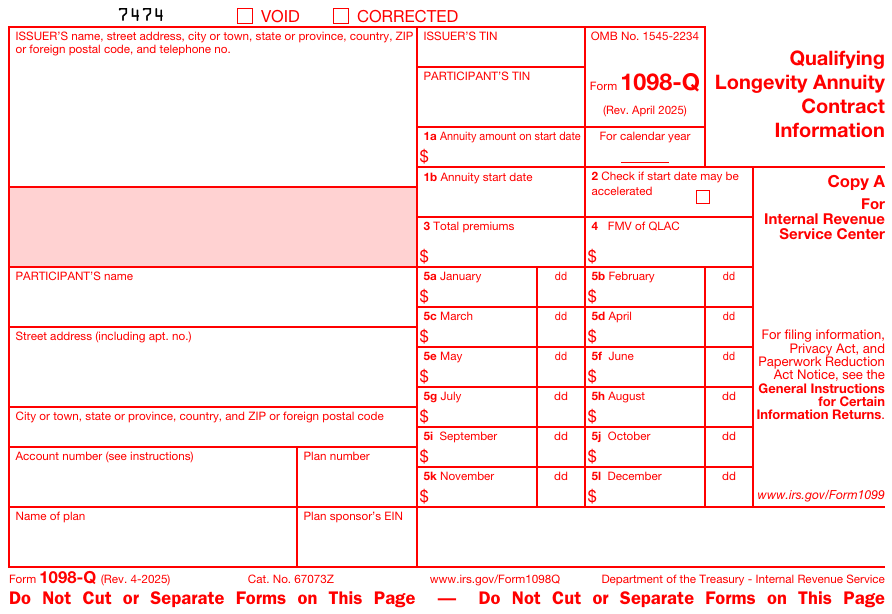
Who must file Form 1098-Q
Any person who issues a contract intended to be a QLAC under Regulations 1.401(a)(9)-6 that is purchased or held under a qualified plan, a 403(a) or 403(b) plan, a governmental 457(b) plan or an IRA (other than a Roth IRA) must file Form 1098-Q and furnish a statement to the participant, for each calendar year beginning with the year of the first premium and ending with the year before the annuity starting date. A QLAC is a deferred annuity meeting the regulation's limits on premiums (the inflation-indexed dollar limit, $200,000 for 2025) and on start date (no later than the first of the month after the participant turns 85), with no commutation or cash surrender value.
The Pub 1099 chart gives February 28 as the IRS date without the March 31 electronic alternative, as it does for 1099-QA. Form 1098-Q is a low-volume online-fillable form under the e-file mandate.
Threshold: All amounts, every QLAC purchased or held under a section 401(a), 403(a), 403(b), 408 (other than Roth) or governmental 457(b) arrangement, for each year until the annuity start date.
What is reported, box by box
| Box | What it reports | Notes |
|---|---|---|
| 1a and 1b | Annuity amount on start date; annuity start date | Amount payable and the date, if determined. |
| 2 | Checkbox: start date may be accelerated | |
| 3 | Total premiums | Cumulative premiums paid for the contract. |
| 4 | FMV of QLAC | As of the close of the calendar year. |
| 5a to 5l | Premiums paid by month | January through December. |
| Plan number, plan name, employer EIN | For contracts held under an employer plan. |
Box titles follow the current revision of the form. The IRS reads the payer and recipient name, TIN, address, account number and the money boxes; the state boxes are for the state copy only.
Payments that are not reported on Form 1098-Q
- Contracts held under a Roth IRA, and annuities that do not meet the QLAC definition (those are reported when distributions begin, on 1099-R).
- Years after the annuity starting date, when 1099-R takes over.
Due dates and extensions
| Copy | Due | For 2026 returns |
|---|---|---|
| To the IRS, paper | February 28 | Monday, March 1, 2027 (February 28 is a Sunday) |
| To the IRS, electronic | February 28 | Monday, March 1, 2027 (February 28 is a Sunday) |
| To the recipient | January 31 | Monday, February 1, 2027 (January 31 is a Sunday) |
An automatic 30-day extension is available on Form 8809, filed by the due date on paper or through IRIS; a second 30 days requires a hardship showing. Recipient statements can be extended 30 days on Form 15397, online or by fax only. 10 or more information returns of any type in aggregate must be e-filed (T.D. 9972); IRIS is the only IRS intake system from filing season 2027, FIRE having been retired. A payer who e-files the originals must e-file the corrections.
For 2026 forms filed in 2027: January 31 falls on a Sunday, so that deadline moves to Monday, February 1, 2027; February 28 also falls on a Sunday, so the paper deadline moves to Monday, March 1, 2027. March 31 (electronic) and March 15 are weekdays. February 28 does not become February 29 in a leap year. The compliance calendar has every date with the weekend shifts applied.
Withholding and TIN matching
No distribution occurs while a 1098-Q is being filed, so neither backup withholding nor pension withholding applies, and the form is not in the IRS TIN Matching program. The participant's name and TIN come from the plan or IRA record, and the same record produces the later 1099-R; a mismatch fixed here is fixed for both.
Name and TIN errors on this form
Every information return is matched by the IRS on the first four characters of the payee's name (the name control) against the TIN. A mismatch produces a CP2100 line the following autumn and, unless the solicitation record is in order, a 972CG penalty the year after: $340 per return for 2026 forms filed in 2027 that are late or wrong, $690 for intentional disregard, with annual maximums of $4,191,500 ($1,397,000 for small filers) under Rev. Proc. 2025-32. The errors that recur on Form 1098-Q:
- Plan-held contracts. The participant is the recipient, under the participant's SSN; the plan and employer are identified separately on the form.
- IRA-held contracts report the IRA owner as participant.
- Spousal survivor features do not change the reported participant until the annuity begins.
The name control calculator shows what the IRS will derive from a name line, and the CP2100 guide covers what to do when the notice arrives.
Recipient statements and substitutes
The recipient statement for Form 1098-Q need not be a copy of the official form: a substitute may be combined with other account statements or reports, provided every required item is numbered and titled as on the official form, the tax year, form number and form name appear together, the recipient instructions are included, and, for the forms Pub 1099 lists, a telephone number with direct access to someone who can answer questions is shown. Publication 1179 (Rev. Proc. 2026-18) has the specifications; logos, slogans and advertising are not permitted on the statement itself. Statements may be furnished electronically only to a recipient who has affirmatively consented in a way that shows they can access the format, after the disclosures in Pub 1099 part M, and must stay posted through October 15. Copy B may show a truncated TIN (xxx-xx-1234); the IRS copy never may.
Corrections and state copies
A wrong amount, code or checkbox is a Type 1 correction: one corrected return with the CORRECTED box checked. A wrong or missing payee TIN, a wrong payee name, or the wrong form type is a Type 2 correction: a zeroed-out copy of the original plus a new original, in that order. Publication 1099 also says you are not required to file a correction for a missing or incorrect TIN if you meet the reasonable-cause standard, only to use the right TIN on the next return, although the IRS encourages the correction. Details and the paper error charts are on the 1099 corrections page.
Form 1098-Q is not in the Combined Federal/State Filing program, so any state that requires it must receive it directly. Requirements by state are on the state pages.
Questions people ask about Form 1098-Q
How long do we keep filing?
Every year from the first premium through the year before payments begin; the FMV in box 4 is what the participant uses to exclude the QLAC from the RMD account balance.
What is the premium limit?
An inflation-indexed dollar amount set by the regulations, $200,000 for 2025 and adjusted in $10,000 increments; excess premiums are returned or the contract fails QLAC status.
Is 1098-Q in the Combined Federal/State program?
No.
Other federal forms
1042-S · 1097-BTC · 1098 · 1098-C · 1098-E · 1098-F · 1098-T · 1098-VLI · 1099-A · 1099-B · 1099-C · 1099-CAP · 1099-DIV · 1099-G · 1099-INT · 1099-K · 1099-LS · 1099-LTC · 1099-MISC · 1099-NEC · 1099-OID · 1099-PATR · 1099-Q · 1099-QA · 1099-R · 1099-S · 1099-SA · 1099-SB · 3921 · 3922 · 5498 · 5498-ESA · 5498-SA · W-2G · 1099-DA · Comparison table
Sources: IRS Publication 1099 (2026), General Instructions for Certain Information Returns, which replaced the separate General Instructions starting with tax year 2026; Instructions for Form 1098-Q (Rev. April 2025); Pub 1099 (2026) Guide to Information Returns; Regulations 1.401(a)(9)-6. Threshold amounts are indexed for inflation from calendar year 2027; check IRS.gov/InflationAdjustment for the current year.