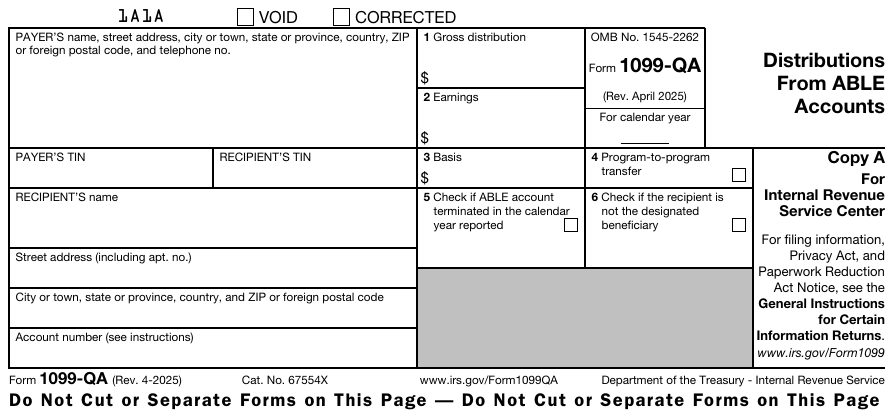
Who must file Form 1099-QA
Any state, or its agency or instrumentality, that establishes and maintains a qualified ABLE program must file Form 1099-QA for each ABLE account from which a distribution was made during the year. The recipient is the designated beneficiary unless the distribution was paid to someone else; a program-to-program transfer is reported with box 4 checked, and termination of the account with box 5. A change of designated beneficiary to an eligible family member is not a distribution.
The Pub 1099 chart gives a single February 28 date for filing with the IRS for this form and Form 1098-Q, without the usual March 31 electronic date. Form 1099-QA is one of the low-volume forms the IRS lets you fill in online and file on paper with Form 1096 if you are under the 10-return e-file mandate; contributions are reported separately on Form 5498-QA, which for 2026 adds box 8 for rollovers from a Trump Account.
Threshold: All amounts, every distribution from an ABLE account; no minimum.
What is reported, box by box
| Box | What it reports | Notes |
|---|---|---|
| 1 | Gross distribution | Cash and the FMV of property distributed. |
| 2 | Earnings | The earnings portion. |
| 3 | Basis | Box 1 minus box 2. |
| 4 | Program-to-program transfer | Checkbox. |
| 5 | ABLE account terminated | Checkbox. |
| 6 | Other than designated beneficiary | Check if the recipient is not the designated beneficiary. |
Box titles follow the current revision of the form. The IRS reads the payer and recipient name, TIN, address, account number and the money boxes; the state boxes are for the state copy only.
Payments that are not reported on Form 1099-QA
- A change of designated beneficiary to a member of the former beneficiary's family.
- Contributions and fair market value, which are reported on Form 5498-QA by May 31 (statement to the beneficiary by March 15).
Due dates and extensions
| Copy | Due | For 2026 returns |
|---|---|---|
| To the IRS, paper | February 28 | Monday, March 1, 2027 (February 28 is a Sunday) |
| To the IRS, electronic | February 28 | Monday, March 1, 2027 (February 28 is a Sunday) |
| To the recipient | January 31 | Monday, February 1, 2027 (January 31 is a Sunday) |
An automatic 30-day extension is available on Form 8809, filed by the due date on paper or through IRIS; a second 30 days requires a hardship showing. Recipient statements can be extended 30 days on Form 15397, online or by fax only. 10 or more information returns of any type in aggregate must be e-filed (T.D. 9972); IRIS is the only IRS intake system from filing season 2027, FIRE having been retired. A payer who e-files the originals must e-file the corrections.
For 2026 forms filed in 2027: January 31 falls on a Sunday, so that deadline moves to Monday, February 1, 2027; February 28 also falls on a Sunday, so the paper deadline moves to Monday, March 1, 2027. March 31 (electronic) and March 15 are weekdays. February 28 does not become February 29 in a leap year. The compliance calendar has every date with the weekend shifts applied.
Withholding and TIN matching
ABLE distributions are not subject to backup withholding and the form is not in the IRS TIN Matching program. Failures are penalized under IRC 6693 at $50 per return with no cap. The designated beneficiary's SSN is established at account opening under the eligibility rules, so mismatches tend to come from a representative or guardian being entered as the account holder.
Name and TIN errors on this form
Every information return is matched by the IRS on the first four characters of the payee's name (the name control) against the TIN. For this form the penalty is IRC 6693: $50 per return for each failure to file or furnish, with no annual maximum, unless the failure was due to reasonable cause. A mismatch still produces a CP2100 line the following autumn. The errors that recur on Form 1099-QA:
- Beneficiary, not the person with signature authority. A parent or guardian who opened and manages the account is not the recipient; the designated beneficiary is.
- Distributions to a third party (a landlord, a school) still report to the beneficiary unless paid to another person as recipient, in which case box 6 is checked.
The name control calculator shows what the IRS will derive from a name line, and the CP2100 guide covers what to do when the notice arrives.
Recipient statements and substitutes
The recipient statement for Form 1099-QA need not be a copy of the official form: a substitute may be combined with other account statements or reports, provided every required item is numbered and titled as on the official form, the tax year, form number and form name appear together, the recipient instructions are included, and, for the forms Pub 1099 lists, a telephone number with direct access to someone who can answer questions is shown. Publication 1179 (Rev. Proc. 2026-18) has the specifications; logos, slogans and advertising are not permitted on the statement itself. Statements may be furnished electronically only to a recipient who has affirmatively consented in a way that shows they can access the format, after the disclosures in Pub 1099 part M, and must stay posted through October 15. Copy B may show a truncated TIN (xxx-xx-1234); the IRS copy never may.
Corrections and state copies
A wrong amount, code or checkbox is a Type 1 correction: one corrected return with the CORRECTED box checked. A wrong or missing payee TIN, a wrong payee name, or the wrong form type is a Type 2 correction: a zeroed-out copy of the original plus a new original, in that order. Publication 1099 also says you are not required to file a correction for a missing or incorrect TIN if you meet the reasonable-cause standard, only to use the right TIN on the next return, although the IRS encourages the correction. Details and the paper error charts are on the 1099 corrections page.
Form 1099-QA is not in the Combined Federal/State Filing program, so any state that requires it must receive it directly. Requirements by state are on the state pages.
Questions people ask about Form 1099-QA
Do we file when the account was only transferred to another state's program?
Yes, a 1099-QA with box 4 checked.
What penalty applies?
$50 per return under IRC 6693, not the IRC 6721 tiers.
Is 1099-QA in the Combined Federal/State program?
No.
Other federal forms
1042-S · 1097-BTC · 1098 · 1098-C · 1098-E · 1098-F · 1098-Q · 1098-T · 1098-VLI · 1099-A · 1099-B · 1099-C · 1099-CAP · 1099-DIV · 1099-G · 1099-INT · 1099-K · 1099-LS · 1099-LTC · 1099-MISC · 1099-NEC · 1099-OID · 1099-PATR · 1099-Q · 1099-R · 1099-S · 1099-SA · 1099-SB · 3921 · 3922 · 5498 · 5498-ESA · 5498-SA · W-2G · 1099-DA · Comparison table
Sources: IRS Publication 1099 (2026), General Instructions for Certain Information Returns, which replaced the separate General Instructions starting with tax year 2026; Instructions for Forms 1099-QA and 5498-QA (Rev. December 2026); Pub 1099 (2026) Guide to Information Returns and part O; IRC 529A, 6693. Threshold amounts are indexed for inflation from calendar year 2027; check IRS.gov/InflationAdjustment for the current year.