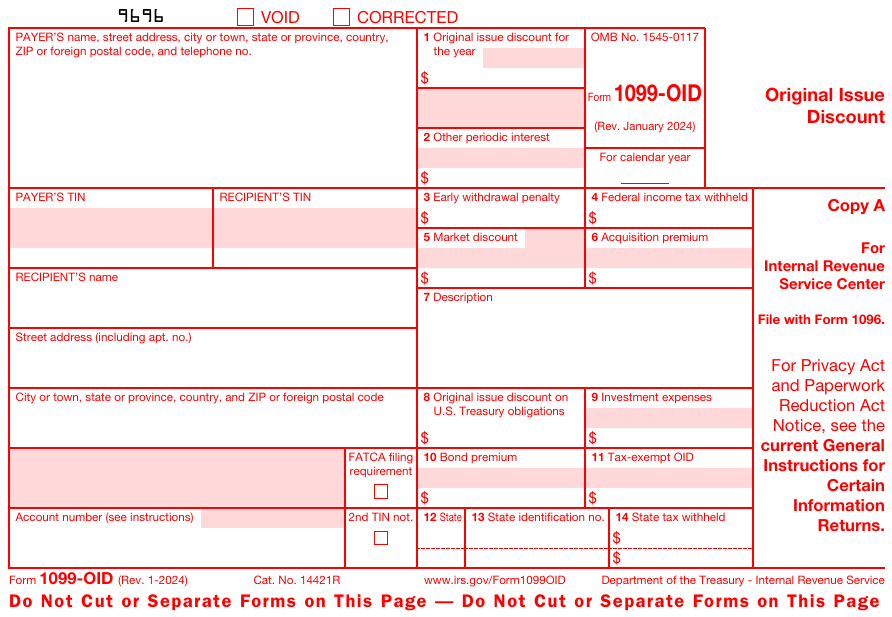
Who must file Form 1099-OID
File Form 1099-OID if the total daily portions of OID for a holder are $10 or more for the year on a debt instrument (including certificates of deposit with a term of more than one year, stripped bonds and coupons, and tax-exempt OID), or if you withheld and paid foreign tax on the OID, or backup withheld. The issuer, or a broker or other middleman holding the instrument for a customer, is the payer. Stated interest on the same instrument may be reported in box 2 rather than on a separate 1099-INT.
Exempt recipients match Form 1099-INT: corporations, tax-exempt organizations, IRAs, governments, dealers and the other categories in Regulations 1.6049-4(c).
Threshold: $10, $10 or more of OID includible in the holder's income for the year; any amount if backup withholding applied.
What is reported, box by box
| Box | What it reports | Notes |
|---|---|---|
| 1 | Original issue discount for the year | Taxable OID on the instrument, before acquisition premium. |
| 2 | Other periodic interest | Stated interest, if you choose to report it here. |
| 3 | Early withdrawal penalty | Time deposits. |
| 4 | Federal income tax withheld | Backup withholding; Form 945. |
| 5 | Market discount | Under a section 1278(b) election. |
| 6 | Acquisition premium | Reduces the OID includible. |
| 7 | Description | CUSIP or description of the instrument. |
| 8 | OID on U.S. Treasury obligations | Exempt from state tax. |
| 9 | Investment expenses | Single-class REMIC. |
| 10 | Bond premium | Covered taxable bonds. |
| 11 | Tax-exempt OID | Municipal instruments. |
| 12 to 14 | State information | Convenience boxes. |
Box titles follow the current revision of the form. The IRS reads the payer and recipient name, TIN, address, account number and the money boxes; the state boxes are for the state copy only.
Payments that are not reported on Form 1099-OID
- Instruments held by exempt recipients; short-term obligations (one year or less) held by the original holder, which are reported when redeemed.
- OID on obligations issued before 1985 in some cases, and de minimis OID under the section 1273 rule.
- OID paid to nonresident aliens reportable on Form 1042-S.
Due dates and extensions
| Copy | Due | For 2026 returns |
|---|---|---|
| To the IRS, paper | February 28 | Monday, March 1, 2027 (February 28 is a Sunday) |
| To the IRS, electronic | March 31 | Wednesday, March 31, 2027 |
| To the recipient | January 31 | Monday, February 1, 2027 (January 31 is a Sunday) |
An automatic 30-day extension is available on Form 8809, filed by the due date on paper or through IRIS; a second 30 days requires a hardship showing. Recipient statements can be extended 30 days on Form 15397, online or by fax only. 10 or more information returns of any type in aggregate must be e-filed (T.D. 9972); IRIS is the only IRS intake system from filing season 2027, FIRE having been retired. A payer who e-files the originals must e-file the corrections.
For 2026 forms filed in 2027: January 31 falls on a Sunday, so that deadline moves to Monday, February 1, 2027; February 28 also falls on a Sunday, so the paper deadline moves to Monday, March 1, 2027. March 31 (electronic) and March 15 are weekdays. February 28 does not become February 29 in a leap year. The compliance calendar has every date with the weekend shifts applied.
Backup withholding and TIN matching
OID is interest for section 3406, so the full interest rules apply: certified TIN required for post-1983 accounts, 60-day awaiting-TIN exemption, C-Notices, CP2100 notices. Withholding is on the cash paid, not the accrued OID. Payers of 1099-OID may use the IRS TIN Matching program.
Name and TIN errors on this form
Every information return is matched by the IRS on the first four characters of the payee's name (the name control) against the TIN. A mismatch produces a CP2100 line the following autumn and, unless the solicitation record is in order, a 972CG penalty the year after: $340 per return for 2026 forms filed in 2027 that are late or wrong, $690 for intentional disregard, with annual maximums of $4,191,500 ($1,397,000 for small filers) under Rev. Proc. 2025-32. The errors that recur on Form 1099-OID:
- The account-titling issues on Form 1099-INT apply verbatim: joint accounts, trusts, custodians and name changes.
- Brokerage sweep and CD programs often carry the customer record from the brokerage side; make sure the 1099-OID payer record is the same name/TIN pair the 1099-INT and 1099-B use, so one W-9 cures all three.
The name control calculator shows what the IRS will derive from a name line, and the CP2100 guide covers what to do when the notice arrives.
Recipient statements and substitutes
Form 1099-OID is subject to the statement mailing rules: the mailing may contain only the statement, a W-9 or W-8, a check or a letter explaining why there is none, the year-end account statement and a letter of tax consequences, with no advertising, and the envelope must carry the legend Important Tax Return Document Enclosed unless it contains only tax statements. A substitute Copy B must use the official box captions and numbers, show the OMB number and the tax year, form number and form name together in one place, bold the federal income tax withheld caption, and include a direct-access telephone number (Publication 1179, section 4.1). Statements may be furnished electronically only to a recipient who has affirmatively consented in a way that shows they can access the format, after the disclosures in Pub 1099 part M, and must stay posted through October 15. Copy B may show a truncated TIN (xxx-xx-1234); the IRS copy never may.
Corrections and state copies
A wrong amount, code or checkbox is a Type 1 correction: one corrected return with the CORRECTED box checked. A wrong or missing payee TIN, a wrong payee name, or the wrong form type is a Type 2 correction: a zeroed-out copy of the original plus a new original, in that order. Publication 1099 also says you are not required to file a correction for a missing or incorrect TIN if you meet the reasonable-cause standard, only to use the right TIN on the next return, although the IRS encourages the correction. Details and the paper error charts are on the 1099 corrections page.
Form 1099-OID is a Combined Federal/State Filing program form: e-file it with the CF/SF election and the IRS forwards it to participating states. Whether that satisfies a given state, or the state wants a direct filing with its own transmittal, is on each state pages.
Questions people ask about Form 1099-OID
Can we report stated interest on the 1099-OID instead of a 1099-INT?
Yes, in box 2, for the same instrument. Do not report it twice.
A CD of 18 months issued at a discount: INT or OID?
OID, if the term is more than one year and the discount is at least the de minimis amount.
Is 1099-OID in the Combined Federal/State program?
Yes.
Other federal forms
1042-S · 1097-BTC · 1098 · 1098-C · 1098-E · 1098-F · 1098-Q · 1098-T · 1098-VLI · 1099-A · 1099-B · 1099-C · 1099-CAP · 1099-DIV · 1099-G · 1099-INT · 1099-K · 1099-LS · 1099-LTC · 1099-MISC · 1099-NEC · 1099-PATR · 1099-Q · 1099-QA · 1099-R · 1099-S · 1099-SA · 1099-SB · 3921 · 3922 · 5498 · 5498-ESA · 5498-SA · W-2G · 1099-DA · Comparison table
Sources: IRS Publication 1099 (2026), General Instructions for Certain Information Returns, which replaced the separate General Instructions starting with tax year 2026; Instructions for Forms 1099-INT and 1099-OID (Rev. January 2024); Pub 1099 (2026); IRC 6049, 1272 to 1278. Threshold amounts are indexed for inflation from calendar year 2027; check IRS.gov/InflationAdjustment for the current year.